
Air Quality · June 25, 2026 · By Doug Kelley, Master Licensed HVAC Technician
Indoor Air Quality on the Shore: What Actually Works, From Filters to UV
Indoor air quality is a field crowded with gadgets and vague promises, which is a shame, because the legitimate tools are genuinely effective when matched to the actual problem. Here is the honest tour, organized by what each tool actually does, with our Shore-specific notes.
Filtration: the foundation
Filtration removes particles: dust, pollen, dander, smoke. The upgrade path that works is a properly sized 4 to 5 inch media filter cabinet, which achieves high filtration without strangling airflow the way an ultra-restrictive 1 inch filter can. For allergy households in our high-pollen springs, moving from a basic filter to a good media cabinet is the single most noticeable change available. What we caution against: cramming a max-MERV 1 inch filter into a system never designed for its resistance, which can cause the airflow problems that lead to frozen coils and overheated furnaces.
Humidity: the Shore's signature issue
Around here, moisture is an air quality problem, not just a comfort one: sustained indoor humidity above 60 percent feeds dust mites and supports mold on cool surfaces. The tools run from correctly sized cooling equipment with long runtimes, through crawlspace vapor barriers, to whole-home dehumidifiers for basements and shoulder seasons. In winter the problem occasionally flips, and furnace-mounted humidifiers, like the units visible in some of our install photos, address the static-and-dry-sinus season. Target zone: roughly 35 to 55 percent year round.
UV and in-duct purification
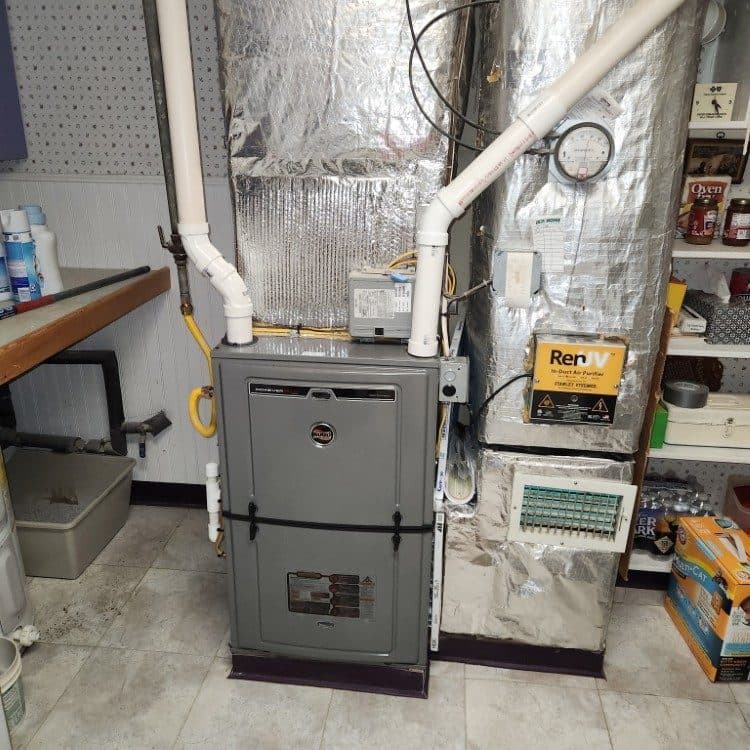
UV lights mounted at the indoor coil do a specific job well: they keep the perpetually damp coil and drain pan from growing the biological film that causes musty AC smell and gradual airflow loss. In our humidity, that is a real and common problem, which is why in-duct purification like the RenUV units we install has a legitimate place, particularly for households sensitive to that must or with long cooling seasons. What we will not do is pitch UV as a cure-all; it sanitizes surfaces and air passing its zone, and it complements filtration rather than replacing it.
Ventilation: the forgotten leg
Modern tightened-up houses can be too sealed for their own good, accumulating cooking byproducts, CO2, and off-gassing. The unglamorous essentials come first: bath fans and range hoods that vent outdoors and actually get used. Beyond that, fresh-air strategies bring in controlled outdoor air, though on the Shore raw fresh-air intakes need humidity thinking attached, since July outdoor air arrives soaking wet.
Where to start, honestly
Not with a gadget. Start with the symptom: allergies point to filtration, musty smells to humidity and coil UV, stuffiness to ventilation, dust to filtration and duct leaks. Matching the tool to the symptom is a ten minute conversation, and it beats owning the wrong equipment: (443) 310-0206.